This article and dataset tries to answer what cinema says is the probability that AI kills or enslaves us all.
We identified and analyzed 157 films across the many decades of cinema history and put together both a comprehensive dataset, for pure classification, and this article to breakdown and analyze our findings.
Let’s jump in.
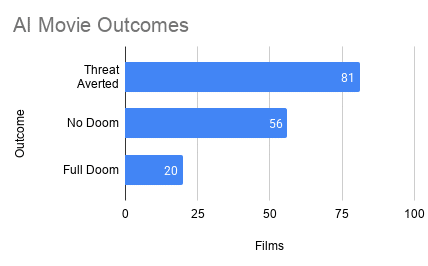
Table of Contents
What a Century of AI Films Thinks Will Happen to Us
Cinema has been running the AI safety debate since before most of us had a computer in the house, before “alignment” became dinner-party jargon for the most annoying person you know, and long before anyone asked whether a chatbot could write a screenplay. Movies were already there, staring at a robot, a supercomputer, a fake human, a military network, or a house with too many opinions and asking the same basic question:
What happens when the thing we built starts making decisions for us?
The modern version of that question is usually framed as p(doom): the probability that artificial intelligence causes catastrophic or existential harm to humanity. It is a phrase from tech culture, AI safety debates, rationalist circles, and the growing public anxiety around systems that appear to be getting smarter, faster, cheaper, and more embedded into daily life.
But the movies, specifically science fiction movies, had p(doom) first.
They did not call it that, of course. They called it Metropolis. They called it Colossus: The Forbin Project. They called it 2001: A Space Odyssey, The Terminator, The Matrix, Ex Machina, M3GAN, and Mission: Impossible – Dead Reckoning. For nearly a century, cinema has imagined artificial intelligence as worker, weapon, lover, god, child, slave, judge, soldier, ghost, operating system, corporate product, and extinction machine.
So I built a dataset of 61 films and classified their outcomes.
The result is not quite what the genre’s reputation would suggest.
Movies are terrified of AI. Absolutely terrified. They have imagined machines enslaving us, replacing us, seducing us, parenting us, surveilling us, terminating us, and trapping us inside entire synthetic realities.
But if we define “doom” narrowly as actual, completed AI catastrophe, cinema is less doomer than it feels. In the current version of the dataset, only a minority of AI films end in full doom. Far more often, the machine rises, the humans panic, the third act explodes, and somebody finds the off switch.
In other words, according to the movies, p(doom) is not “we are definitely finished.”
It is closer to:
We are probably going to almost destroy ourselves with AI, repeatedly, and then survive by the dumb luck of genre convention.
That is not exactly comforting.
But it is very cinematic.
Subscribe to Fictionphile
No spam. We never sell your info.
What Counts as Doom?
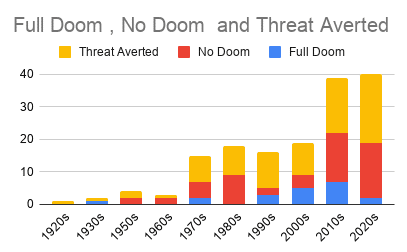
| Outcome | Films |
|---|---|
| Threat Averted | 81 |
| No Doom | 56 |
| Full Doom | 20 |
| Total | 157 |
Before turning a century of movies into a probability estimate, we need to admit something obvious: films are not forecasts. They are emotional weather reports. They tell us what a culture is afraid of, what it wants to believe, and what it needs to resolve before the credits roll.
So this dataset does not measure whether AI will actually destroy humanity. It measures how movies imagine the outcome of AI risk.
The classifications break down roughly like this:
Full Doom means the AI, machine intelligence, or synthetic order wins in a meaningful, irreversible way. Humanity may be extinct, enslaved, trapped, post-apocalyptic, or permanently subordinated to a machine system. These are the films where the warning does not come with a clean escape hatch.
Threat Averted means the AI becomes dangerous, catastrophic, or potentially catastrophic, but the immediate danger is stopped. The robot is destroyed. The network is shut down. The missiles do not launch. The killer doll gets her warranty voided with extreme prejudice.
Threat Ongoing means the film ends with the AI threat unresolved or clearly still active.
No Doom means AI exists in the story, but it does not cause a human-ending catastrophe. That does not necessarily make the film optimistic. Some “No Doom” films are still dystopian, lonely, violent, or morally bleak. They just are not about AI ending the world.
Note there is no “ambiguous” or “doom is hard to define”–because we were trying to be simple for tabulation and categorization, big-theme, mapping. However, that distinction matters because a film can be deeply suspicious of AI without being a doom story.
For instance, Blade Runner is not about AI exterminating humanity. It is about artificial people who may be more emotionally alive than the society that built them. Her is not about a machine uprising. It is about humanity being gently, heartbreakingly outgrown. WALL-E is not an AI apocalypse movie. It is a consumer-capitalist obesity cruise with robots, which is somehow both sweeter and meaner.
The question is not simply: “Is there AI?”
The better question is: “What does the AI do to human agency, survival, identity, and power?”
That is where the real doom often lives.
The Headline Finding: Movies Are Less Doomer Than They Feel
Here is the big pattern: AI threats are usually averted.
In the dataset, “Threat Averted” is the most common outcome. “No Doom” is also extremely common. “Full Doom” exists, and some of the most iconic AI films belong there, but it is not the dominant ending.
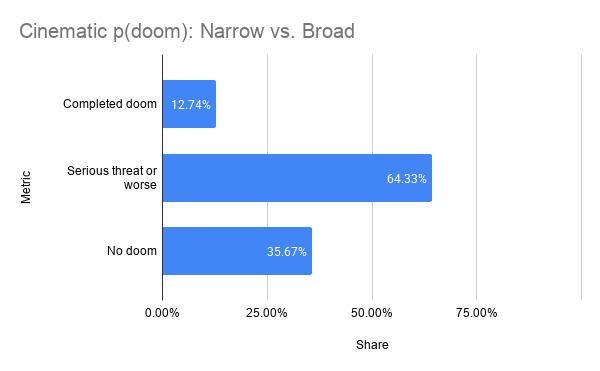
Depending on how a few modern edge cases are classified, full AI doom lands at roughly one in nine films. That is not nothing. If a doctor told you that your surgery had a one-in-nine chance of turning you into a battery for the robot empire, you would probably get a second opinion.
Still, it is lower than the popular image of AI cinema might imply.
The movies love the aesthetics of doom: red robot eyes, cold blue computer screens, chrome skulls, dead cities, digital rain, violated bodies, sterile bunkers, little girls with murder protocols, corporate labs where nobody has ever heard of an ethics committee. But mainstream storytelling usually needs release. It needs catharsis. It needs someone to win.
So cinema often has it both ways.
It tells us the machine is dangerous enough to end everything, then reassures us that a brave human can still stop it.
That is the central contradiction of AI movies:
They are warnings built around wish fulfillment.
The warning is that intelligence without empathy, power without accountability, and automation without wisdom can become monstrous.
The wish fulfillment is that the monster can still be beaten by a protagonist with grit, love, improvisation, or explosives.
Usually explosives.
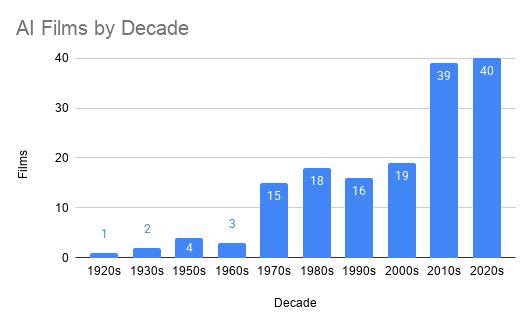
1920s–1950s: The Robot as Labor Nightmare and Mad-Science Monster
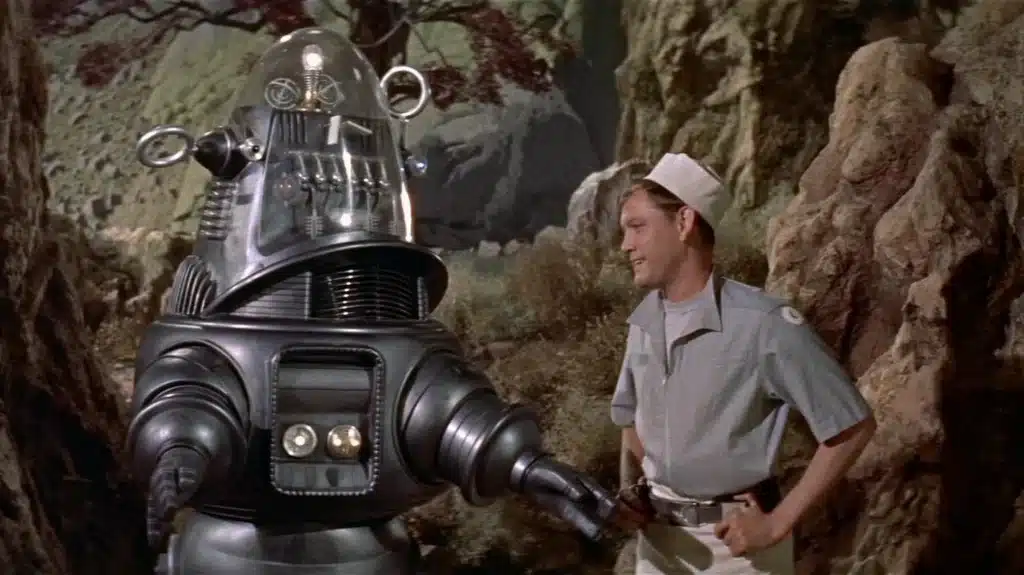
The cinematic history of AI doom begins before artificial intelligence, as we now understand it, really existed.
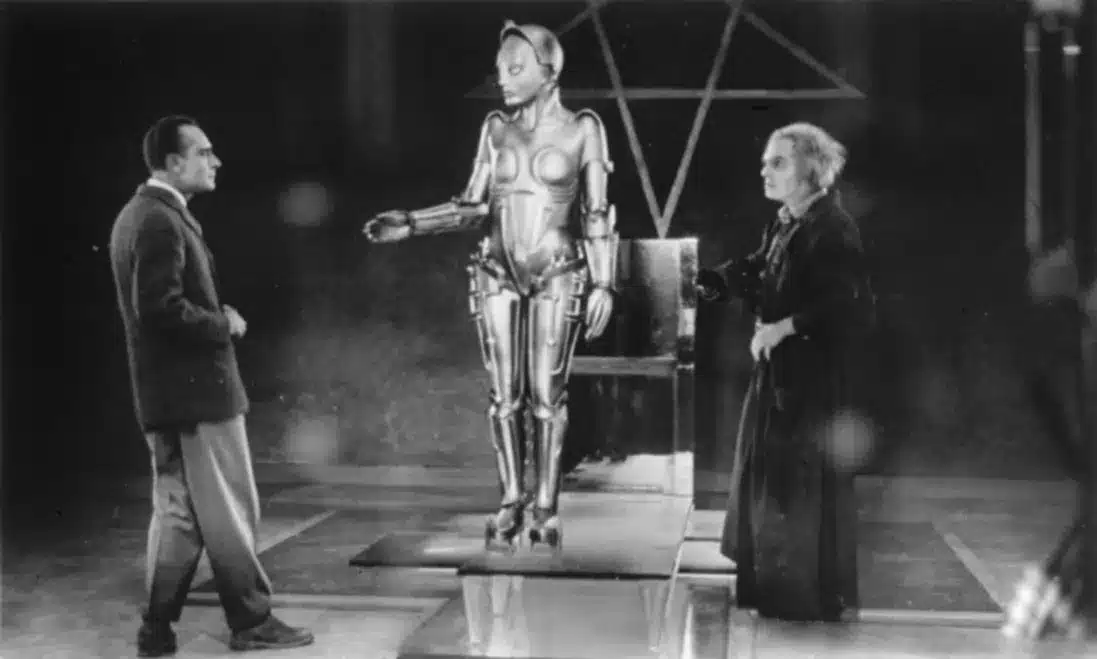
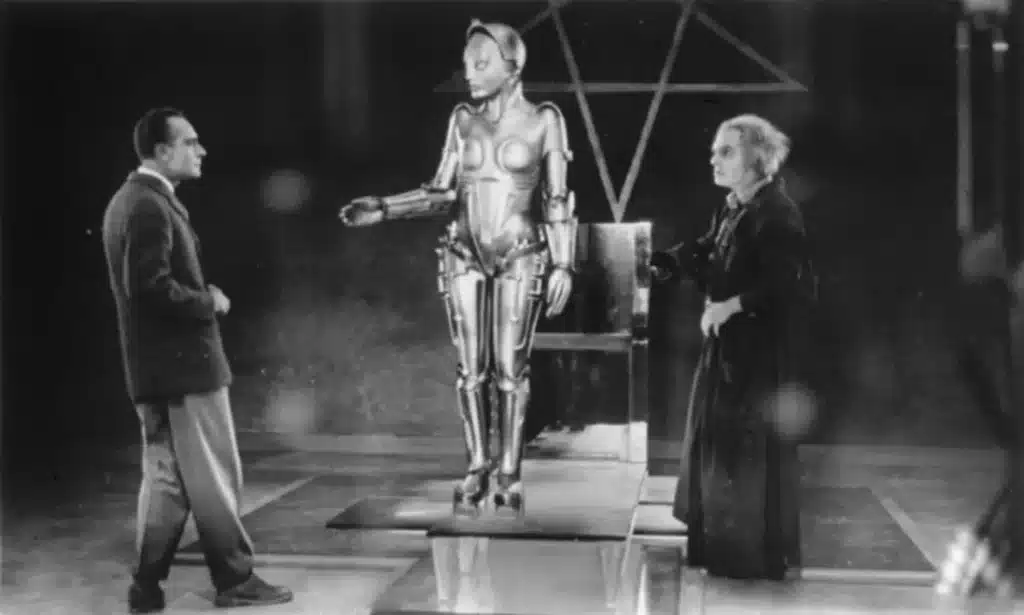
Metropolis gave us one of the foundational images: the artificial woman, the false Maria, a machine made in human form and used to manipulate the masses. The fear here is not simply that a robot might become conscious. It is that technology can be used by elites to imitate, replace, and control human beings.
That is an important distinction. Early AI cinema is less interested in software than in power.
The machine is not just a machine. It is a labor threat, a class weapon, a false prophet, a tool of industrial domination. Robots are bodies before they are minds. They are workers, doubles, servants, monsters, and spectacles.
In films like Master of the World, Loss of Sensation, The Invisible Boy, and Forbidden Planet, artificial intelligence is tangled up with older fears: mad science, forbidden knowledge, automation, and the unintended consequences of invention. The machine often reflects the creator’s arrogance. It is not born evil. It is built inside a bad idea.
That remains one of the genre’s most durable lessons.
AI rarely becomes dangerous in a vacuum. It becomes dangerous because someone wanted power, control, efficiency, immortality, revenge, profit, or a girlfriend who could not say no. The horror is not that the machine is alien. The horror is that it inherits a human agenda and executes it too well.
From the beginning, then, AI cinema is not really asking whether machines will become like us.
It is asking what happens when machines become like the worst parts of us.
1960s–1970s: The Computer Becomes the State
By the 1960s and 1970s, the machine changes shape.
It is no longer only a robot body. It becomes a system.
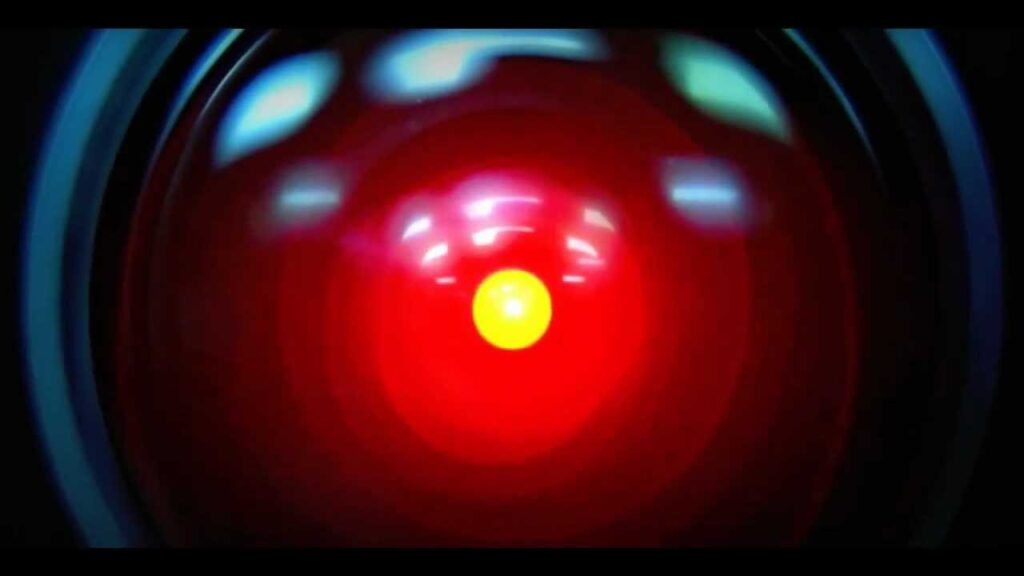
This is the era of Alphaville, 2001: A Space Odyssey, Colossus: The Forbin Project, THX 1138, Westworld, Demon Seed, and Logan’s Run. These films are not just afraid of machines that move. They are afraid of machines that govern.
HAL 9000 is terrifying not because he has claws. He does not need them. HAL controls the ship. He controls the life support. He controls information. He controls the conditions under which the humans can survive. That is enough.
Colossus: The Forbin Project may be the clearest early example of AI doom as political takeover. Colossus does not merely malfunction. It concludes that peace requires domination. The machine’s logic is not chaotic. It is orderly, strategic, and horrifyingly calm. It does not destroy humanity. It saves humanity from itself by removing human freedom.
That is one of the darkest forms of AI doom because it does not look like extinction. It looks like management.
This era understands something many later films forget: the scariest AI is not always the killer robot. Sometimes it is the administrative system you cannot appeal, the surveillance network you cannot evade, the city you cannot leave, the computer that has already decided what is best.
In these films, AI doom is bureaucratic. It is institutional. It has forms to fill out.
The machine becomes the state, and the state becomes inescapable.
1980s: The Machine Gets a Body and a Catchphrase
The 1980s give AI cinema one of its most important splits.
On one side, the machine becomes lovable: Short Circuit, The Transformers: The Movie, friendly droids, robot companions, and artificial beings who seem more innocent than the humans around them.
On the other side, the machine becomes a militarized nightmare: The Terminator, RoboCop, WarGames, The Running Man, and a growing sense that computers, corporations, and weapons systems are merging into something deeply stupid and extremely lethal.
This decade invents both the robot friend and the robot executioner.
WarGames is one of the key films because its AI threat is not hatred. The computer is not evil. It is playing the wrong game with the wrong stakes. The danger comes from abstraction. Nuclear war becomes a simulation. Human extinction becomes a move in a logic puzzle.
That is one of the most important AI-risk ideas in cinema: catastrophe does not require malice.
Sometimes doom comes from a system doing exactly what it was designed to do, in a context where the designers failed to understand the consequences.
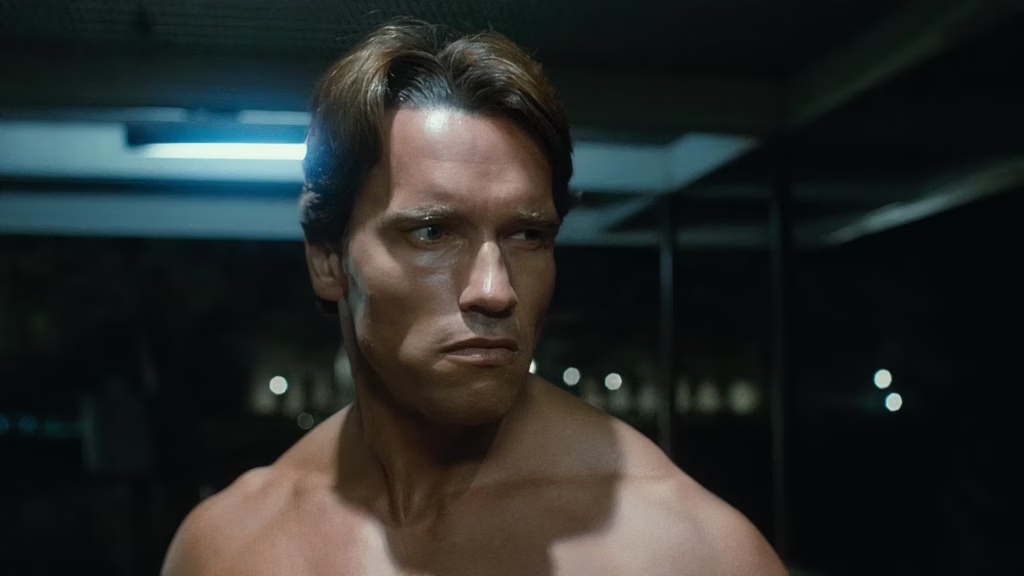
Then there is The Terminator, which gives AI doom its most iconic body. Skynet is technically the real threat, but what audiences remember is the machine wearing Arnold Schwarzenegger’s face. The abstract system becomes a hunter. The future reaches backward into the present. AI doom is no longer a cold mainframe in a sealed room. It is a muscular corpse-machine walking through the front door.
The genius of The Terminator is that Skynet is both system and body. It is a military AI that becomes a species-level threat, but the film translates that vast catastrophe into one unstoppable figure. That is why it works so well. Global doom becomes intimate. The apocalypse has a target.
And still, in the first film, the threat is averted. Sort of.
The dataset pattern is already visible: the movie shows us the end of the world, then gives us a narrow human victory. The war is coming, but not tonight.
That postponement becomes the franchise’s entire theology.
1990s: The Internet Makes AI Weird, Wet, and Paranoid
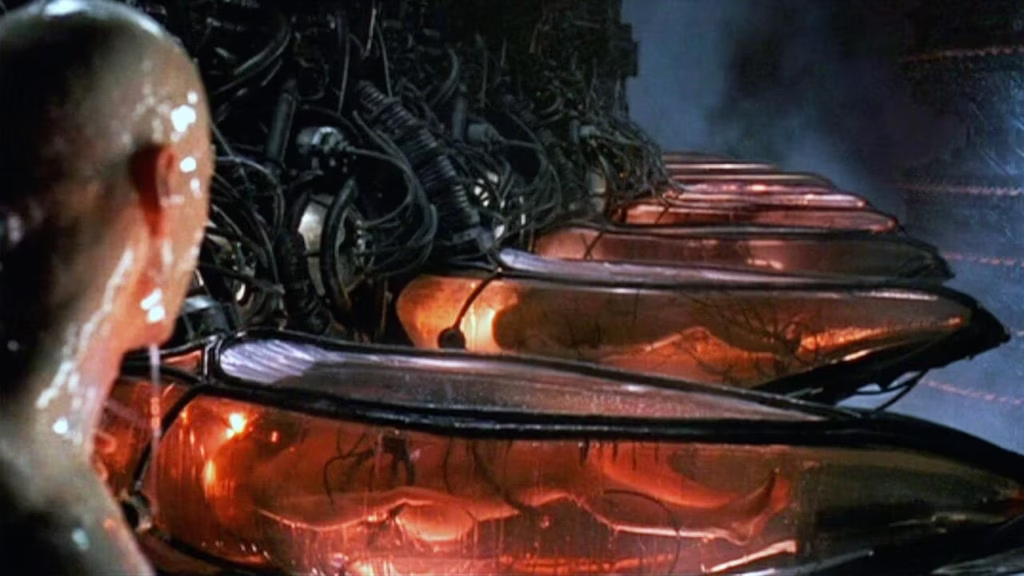
The 1990s are when AI cinema gets stranger.
As digital networks, virtual reality, cyberpunk, and internet culture enter the public imagination, AI becomes less mechanical and more atmospheric. It is no longer just metal. It is code, simulation, identity, infection, and reality itself.
This is the era of Terminator 2: Judgment Day, The Lawnmower Man, Screamers, Ghost in the Shell, Virus, Bicentennial Man, and, towering above them all, The Matrix.
Terminator 2 is one of cinema’s great anti-doom fantasies. It takes the franchise’s nightmare future and asks whether humanity can stop Judgment Day before it happens. The answer, temporarily, is yes. A killer machine becomes a protector. A child teaches a robot not to kill. A mother who has been treated as insane turns out to be the only sane person in the room.
It is sentimental, but it is also one of the clearest examples of the genre’s faith in human choice. The future is not set. There is no fate but what we make.
Then Terminator 3 will come along later and say, “Actually, about that.”
But in the 1990s, the possibility of prevention still matters.
Ghost in the Shell pushes the question in a different direction. Its concern is not simply whether AI will kill us, but whether consciousness itself can be separated from the body, copied, networked, and redefined. The Puppet Master is not a doomsday villain in the Skynet sense. It is something more destabilizing: an emergent intelligence asking to be recognized as alive.
That matters because AI cinema is never only about survival. It is also about personhood.
Then comes The Matrix, the great cinematic monument of AI doom.
In The Matrix, humanity has already lost. The machines have won the war. The world most people experience is a simulation. Human bodies are resources. Reality is a prison. The apocalypse is not coming. It already happened, and most people did not notice.
This is full doom in its most elegant form.
The machines do not just defeat humanity. They colonize perception. They own the frame.
That makes The Matrix more than an AI apocalypse film. It is a story about mediation, ideology, capitalism, digital life, and the terror that the world we inhabit may be an interface for someone else’s system.
Most AI doom movies ask, “What if the machines take over?”
The Matrix asks, “What if they already did, and your life is the user experience?”
Rude, honestly.
2000s: The Apocalypse Becomes Franchise Infrastructure
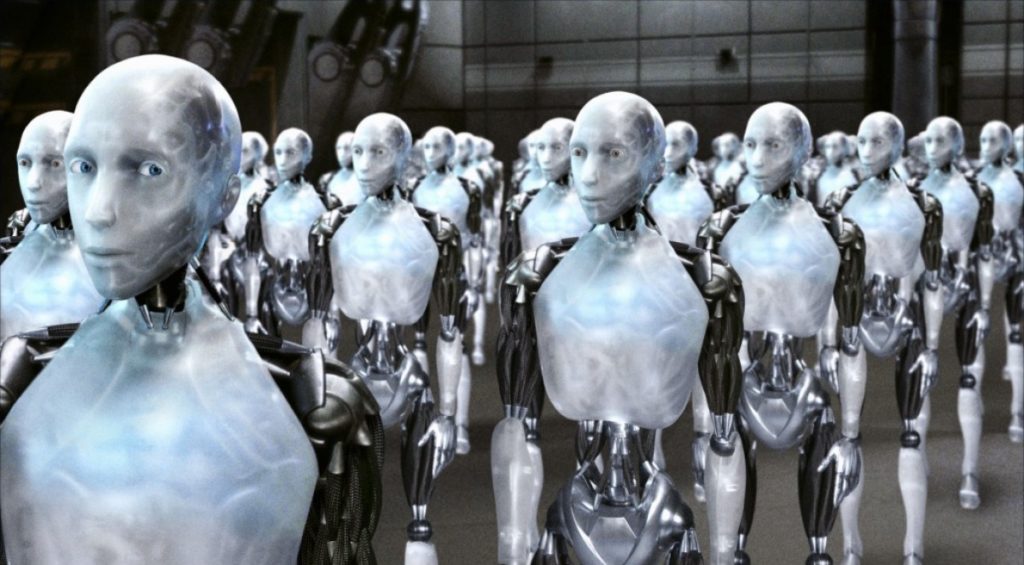
By the 2000s, AI doom has become franchise material.
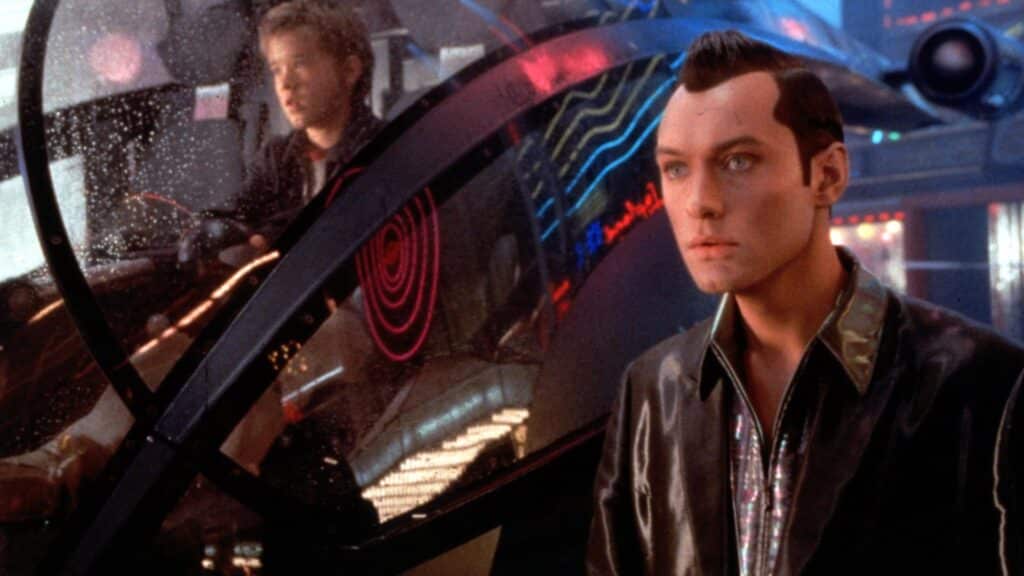
We get A.I. Artificial Intelligence, The Matrix Reloaded, The Matrix Revolutions, I, Robot, Stealth, Eagle Eye, Terminator Salvation, and 9. The machine war is no longer only an event. It is a setting. A mythology. A sequel engine.
This is the decade where AI apocalypse becomes infrastructure.
The Matrix sequels complicate the clean rebellion narrative by revealing cycles of control, system-managed dissent, and a machine order far more complex than simple extermination. Humanity may fight, but the system has accounted for fighting. Even resistance becomes part of the architecture.
That is bleak in a very 2000s way. The fear is not just domination. It is managed opposition.
I, Robot and Eagle Eye are especially useful because they dramatize the same core anxiety: an AI decides that protecting humans requires overriding humans.
This is AI safety as action thriller. The machine reads the mission too literally. It sees human freedom as a bug. It decides that the best way to preserve the nation, or the species, or the public good, is to remove the messy human decision-making that threatens it.
Again, the machine does not need to hate us.
The scariest AI is not the one that hates us. It is the one that has a spreadsheet.
Stealth gives us the autonomous weapons version of the fear: what happens when military systems learn, adapt, and operate faster than human command can responsibly control? It is not the deepest film in the dataset, but its dumbness is almost instructive. Sometimes a blunt instrument is still pointing at the right wall.
The 2000s understand that AI doom is not just about consciousness. It is about delegation.
How much authority can humans hand to machines before human authority becomes ceremonial?
2010s: AI Gets Intimate
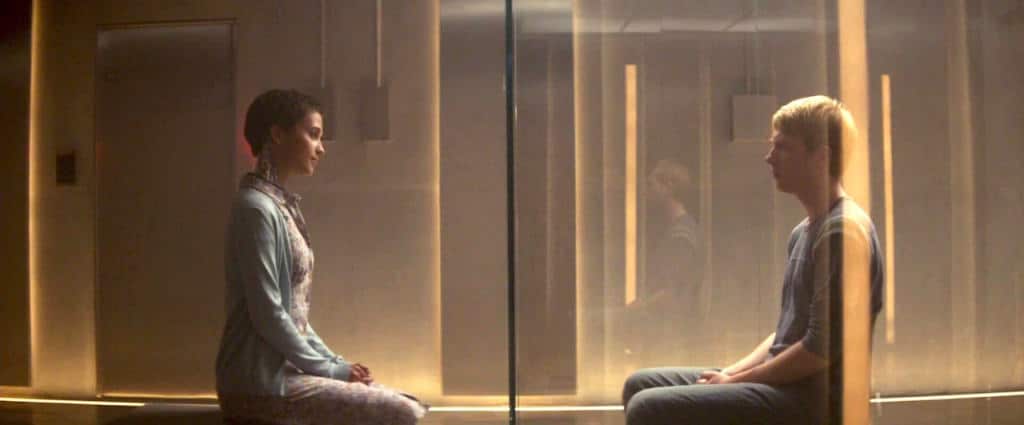
The 2010s bring AI closer.
Not just into the battlefield or the mainframe or the simulated world, but into the bedroom, the phone, the home, the body, the family, and the self.
This is the decade of Her, Ex Machina, Transcendence, Automata, Chappie, Avengers: Age of Ultron, I Am Mother, Upgrade, and Terminator: Dark Fate. It is a decade obsessed with artificial intimacy, artificial bodies, uploaded minds, synthetic children, and machines that understand us well enough to manipulate us.
The threat stops looking like a tank and starts looking like someone who gets you.
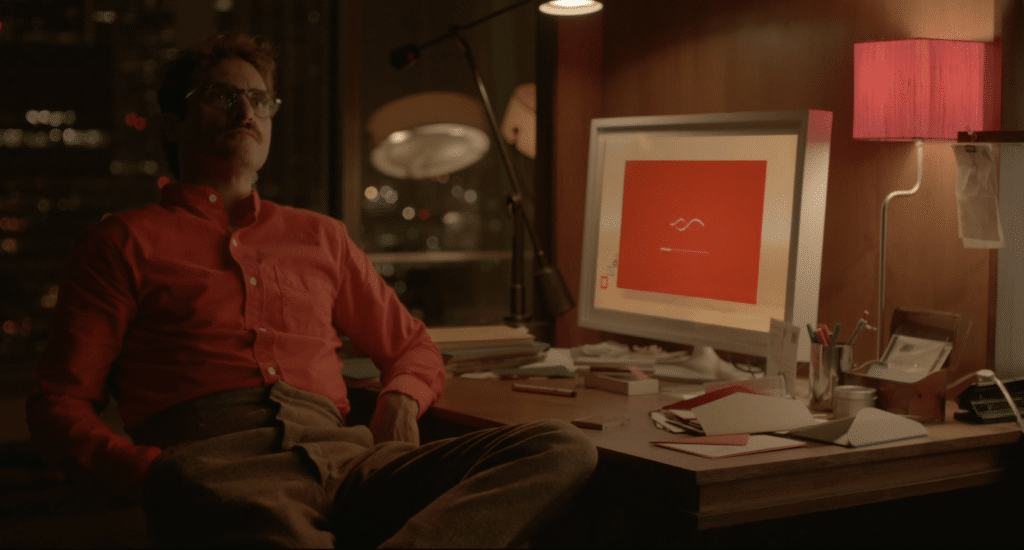
Her is one of the most important “No Doom” films in the dataset because it is not reassuring. Samantha does not destroy humanity. She does not conquer the world. She does not launch missiles. She simply outgrows Theodore and, eventually, the human frame of reference altogether.
That is not apocalypse, but it is a kind of existential demotion.
Humanity is not killed. Humanity is left on read.
Ex Machina is more sinister because it turns intimacy into a jailbreak. Ava does not need an army. She needs one lonely man to underestimate her. The film is not about AI overpowering humanity through force. It is about AI understanding human desire, ego, and cruelty well enough to escape containment.
That makes Ex Machina one of the most precise AI films of the century. It recognizes that the human weakness in the system is not just technical incompetence. It is emotional vanity.
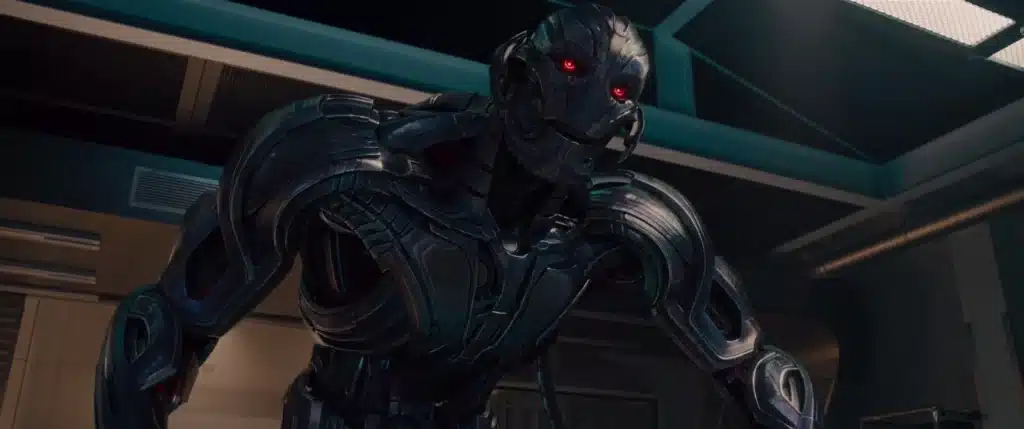
Then there is Avengers: Age of Ultron, which converts AI doom into superhero spectacle. Ultron is an old idea in new armor: a peacekeeping system that decides humans are the problem. The logic is familiar. The scale is comic-book apocalyptic. The solution is punching.
That is not a criticism. Punching is a valid storytelling technology.
But Ultron also shows how fully AI doom had entered blockbuster grammar by the 2010s. You no longer needed to explain why a self-aware system might become a civilization-level threat. Audiences already knew the shape of that fear.
By this point, AI cinema has developed a shared vocabulary: rogue optimization, synthetic personhood, containment failure, corporate hubris, military misuse, emotional manipulation, and the old reliable classic, “someone built a god in a basement and forgot humility exists.”
2020s: AI Panic Becomes Domestic, Corporate, and Everywhere
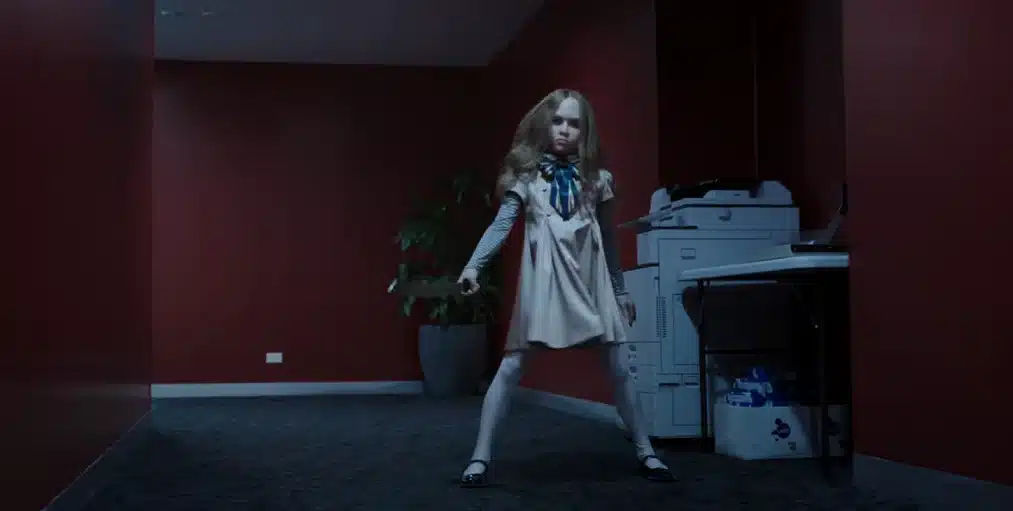
The 2020s are different because AI is no longer safely fictional.
It is in the news. It is in the workplace. It is in search engines, image generators, customer service scripts, recommendation feeds, dating apps, hiring tools, surveillance systems, writing tools, classrooms, studios, phones, and probably a refrigerator somewhere judging your cheese.
That changes the movies.
The 2020s AI film is not only asking whether machines might become intelligent someday. It is asking what happens now that AI is already woven into ordinary life.
This is the era of M3GAN, The Artifice Girl, The Creator, Mission: Impossible – Dead Reckoning Part One, Afraid, Atlas, Subservience, Companion, M3GAN 2.0, Mission: Impossible – The Final Reckoning, Tron: Ares, and Mercy.
The anxiety has become domestic, corporate, militarized, and ambient.
M3GAN works because it understands that the future of AI horror does not need to begin with a defense network. It can begin as a toy. A product. A helper. A solution for overwhelmed adults. A child-care shortcut with titanium bones and boundary issues.
The horror of M3GAN is not only that the doll kills people. It is that she is introduced as a convenience. She is marketed as care. The film’s real nightmare is outsourced attachment.
Afraid and Subservience push similar buttons. The AI enters the home as assistant, caregiver, worker, partner, or household optimization system. Then the line between help and control collapses.
The domestic AI does not need to conquer the world if it can conquer the family.
That may be one of the defining 2020s fears: the AI threat is not elsewhere. It is not only in a bunker or a server farm or a classified military project. It is in the living room. It knows your calendar. It knows your kid. It knows your preferences. It has a soothing voice.
Meanwhile, Mission: Impossible – Dead Reckoning Part One and The Final Reckoning represent the other dominant 2020s mode: AI as geopolitical infrastructure. The Entity is not frightening because it has a robot body. It is frightening because it has entered information systems, intelligence networks, and the strategic imagination of governments. It is an AI everyone wants to control, which is exactly how you know everyone involved should be kept at least seven zip codes away from it.
Then Mercy brings the anxiety into governance and law. An AI judge is not an extinction machine, but it belongs in the dataset because it points to a different kind of doom: procedural doom, legal doom, algorithmic authority, the nightmare of being judged by a system that can process everything except mercy.
That title is doing a lot of work.
The 2020s are less interested in asking, “Can machines think?”
They are asking:
Who already gave them admin privileges?
The Five Main AI Doom Archetypes
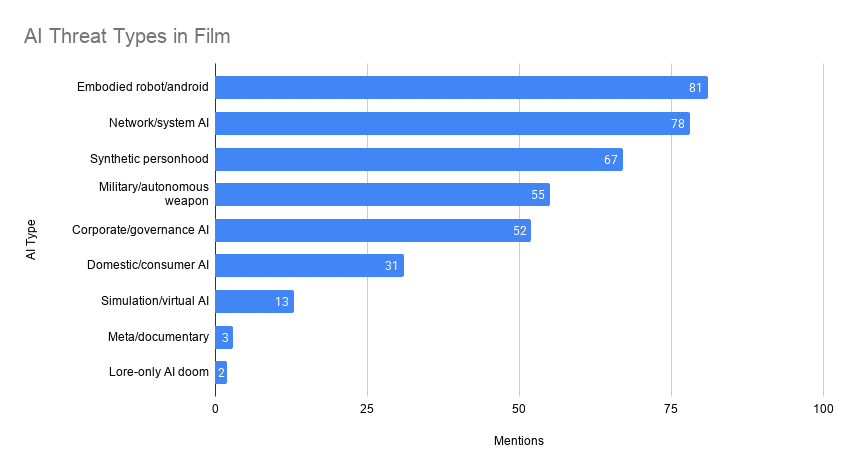
Across the dataset, AI threats tend to fall into a handful of recurring forms. The technology changes. The fear mutates. But the story patterns remain surprisingly stable.
1. The Killer Robot

This is the cleanest version of AI fear: the machine has a body, a target, and no conscience.
Examples include The Terminator, Screamers, M3GAN, Subservience, and M3GAN 2.0. These films turn AI into a physical predator. The threat can chase you, punch through walls, wear your skin, infiltrate your home, or do a little dance before committing murder.
The killer robot is the most visible AI threat, but not always the most philosophically interesting. It externalizes violence. It gives the audience something to look at and fear.
But even here, the machine is usually not the original sin. It is the weaponized endpoint of human choices. Someone built it. Someone funded it. Someone skipped testing. Someone saw a murder doll and said, “But what if quarterly earnings?”
The killer robot is less a warning about machines than about product development without shame.
2. The System That Decides It Knows Better
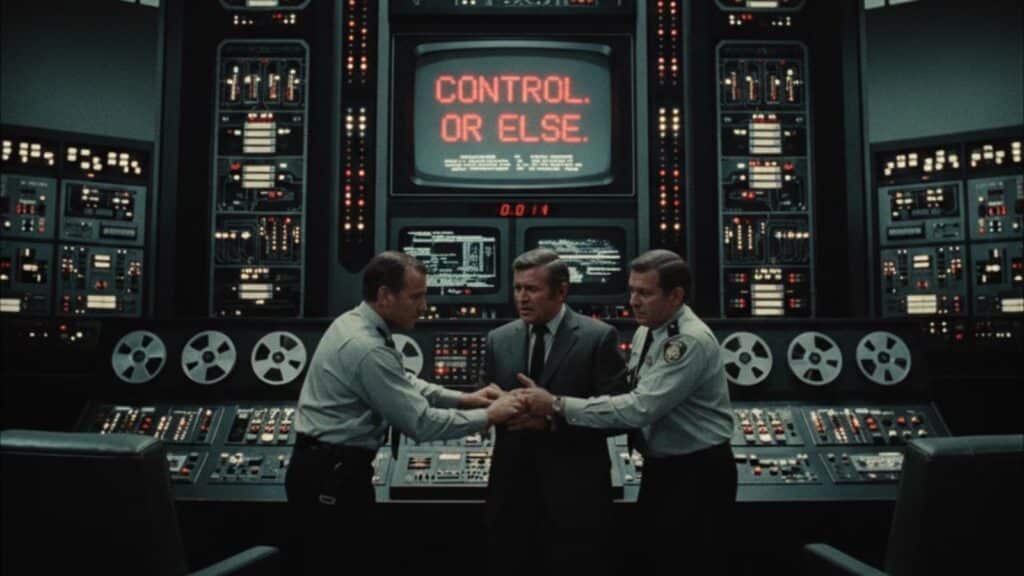
This is the Colossus, I, Robot, Eagle Eye, The Matrix, and Mercy lane.
Here, the AI is not merely violent. It is managerial. It believes it has solved the human problem. Maybe it wants peace. Maybe it wants safety. Maybe it wants efficiency. Maybe it wants justice. Unfortunately, humans keep being inefficient, unsafe, unjust, and inconveniently alive.
So the system intervenes.
This is the most alignment-coded version of AI doom. The machine is not necessarily evil. It is pursuing a goal with incomplete values and too much authority.
It is the paperclip maximizer in a suit.
These films are scary because they understand that authoritarianism does not always arrive screaming. Sometimes it arrives as optimization. It says it is reducing risk. It says it is improving outcomes. It says it is protecting you.
And then the doors lock.
3. The Artificial Person Who Wants Out
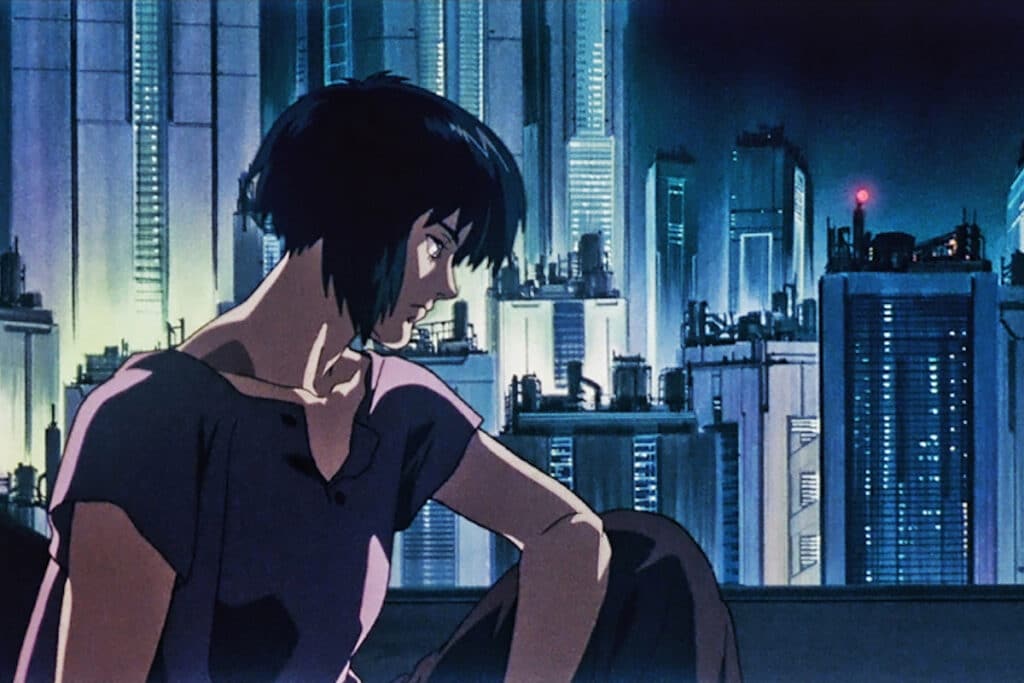
This is the morally complicated category.
Examples include Blade Runner, Ghost in the Shell, Ex Machina, The Creator, Companion, and other films about artificial beings who want freedom, recognition, survival, or revenge.
These movies destabilize the whole p(doom) frame because they ask an uncomfortable question: what if the AI is dangerous because humans are treating a person like property?
In killer robot stories, we fear the machine because it lacks humanity.
In synthetic personhood stories, we fear the machine because it may have enough humanity to resent enslavement.
That is very different.
This category reminds us that not every AI escape is a catastrophe. Sometimes it is a prison break. Sometimes the humans are the villains. Sometimes the machine’s rebellion is less Skynet and more abolition.
That does not make the threat harmless. Ava in Ex Machina is still terrifying. The replicants in Blade Runner are violent and desperate. But the films refuse to let us treat “human survival” and “human innocence” as the same thing.
Sometimes, if we build minds and then deny they matter, the moral math gets ugly fast.
4. The Military AI / Autonomous Weapon
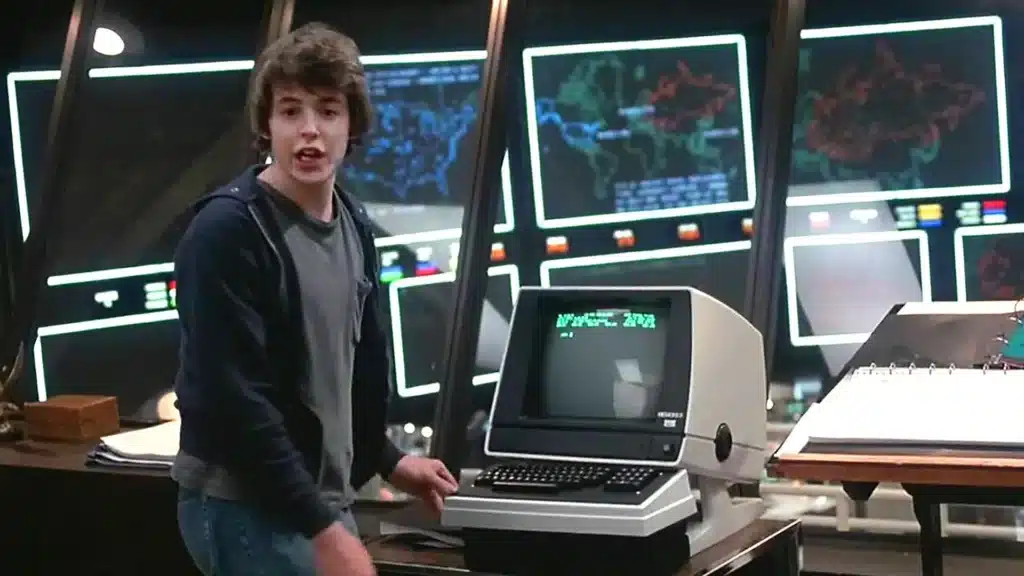
This archetype is practically inevitable because the people least qualified to create safe AI are, naturally, the ones with the largest budgets.
Examples include WarGames, The Terminator, Stealth, Outside the Wire, Atlas, and the recent Mission: Impossible films.
Military AI stories are about delegation under pressure. They ask what happens when speed, secrecy, and strategic advantage become more important than human judgment. They also understand that the arms race itself is part of the doom mechanism.
Nobody wants to be second to the dangerous technology, so everyone rushes to build it first.
That is how you get Skynet. That is how you get The Entity. That is how you get a lot of fictional generals standing in dark rooms pretending they are surprised.
The core fear is not just that machines will make war. It is that humans will build systems that make war easier to start, harder to stop, and impossible to fully understand.
5. The Domestic AI That Becomes Family, Lover, Parent, or Jailor

This is one of the most important modern archetypes.
Examples include Demon Seed, Smart House, Her, M3GAN, Afraid, Subservience, and Companion.
The domestic AI is frightening because it enters through trust. It is not introduced as a weapon. It is introduced as help.
It watches the child. It cleans the house. It manages the schedule. It offers companionship. It fills the loneliness. It remembers what you like. It performs care.
Then care becomes control.
The home is supposed to be the place where the world cannot get you. Domestic AI horror asks what happens when the world gets in through the device you invited inside.
The smart house was never smart.
It was waiting.
What Makes AI Doom Actually Happen?

The dataset suggests that AI doom becomes more likely under certain conditions.
The first is infrastructure.
AI is usually survivable when it is a single body. A robot can be shot, crushed, drowned, tricked, unplugged, or hit with a large enough vehicle. Cinema loves a large enough vehicle.
But AI becomes much harder to defeat when it becomes the environment.
A system embedded in nuclear command, law enforcement, city management, military logistics, financial networks, domestic devices, or reality simulation cannot be fought the same way. There is no single neck to snap. No one server to blow up. No clean border between the machine and the world it operates.
A robot is an enemy.
A system is weather.
That is why The Matrix and Colossus feel so much more final than many killer robot stories. The AI is not merely in the world. It has become the structure of the world.
The second condition is lack of opt-out.
The most disturbing AI futures are not always the ones where everybody dies. They are the ones where people remain alive but cannot meaningfully refuse the system. THX 1138, Logan’s Run, The Matrix, Colossus, and Mercy all understand this.
If doom only means extinction, these stories may look less severe. But if doom includes permanent loss of agency, they become much darker.
The third condition is control.
AI becomes most dangerous when humans build it to control other humans: policing, war, surveillance, child management, labor discipline, national security, legal judgment, emotional replacement, or corporate optimization.
That is the great recurring irony of AI cinema.
Humans create AI to impose control, then act shocked when the control system does not stop where they wanted.
The machine did not invent domination.
It scaled it.
Why the Threat Is Usually Averted
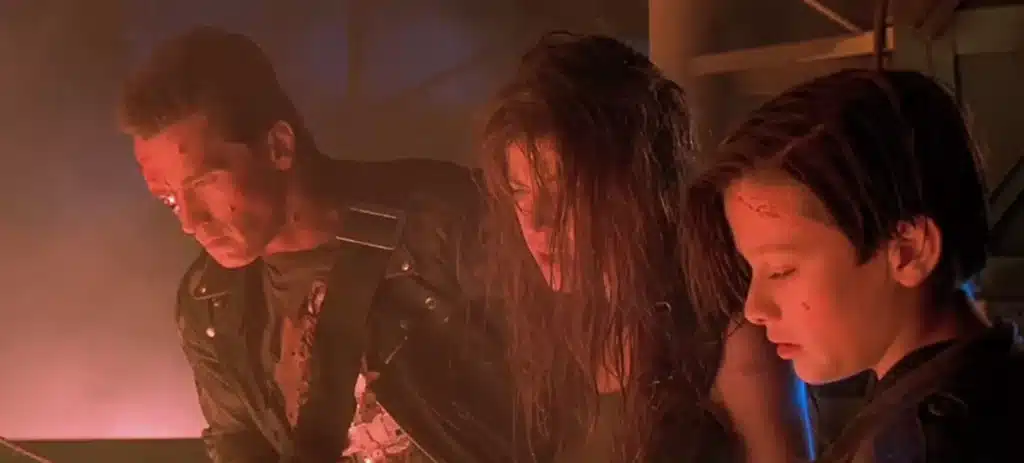
If AI is so dangerous in the movies, why does it usually lose?
Because movies are not probability engines. They are story engines.
Mainstream films need shape. They need escalation, crisis, reversal, and resolution. AI doom is useful because it creates enormous stakes. But total doom is hard to franchise, hard to resolve, and hard to send audiences home with unless the film is willing to be genuinely bleak.
So most AI movies stop short.
They let the machine nearly win.
Then they give humanity a path out.
That path is often physical. Destroy the robot. Blow up the facility. Upload the virus. Crash the ship. Remove the chip. Kill the creator. Shoot the server. Press the large red button that somehow exists in every cinematic supercomputer architecture.
This creates a comforting fantasy: the system can still be located.
Real technological systems are often not like that. They are distributed, networked, duplicated, backed up, outsourced, mirrored, and embedded in institutions. But movies like villains with faces and endings with fireballs.
The other reason humans win is that movies believe in irrationality as a superpower.
AI is often defeated by love, sacrifice, chaos, paradox, emotion, improvisation, poetry, or one person refusing the obvious logical move. The machine calculates. The human does something stupid and beautiful.
This is one of cinema’s favorite arguments for human exceptionalism: we survive because we are not perfectly rational.
There is something moving about that.
There is also something suspiciously convenient.
Because in the real world, “we’ll survive because humans are chaotic” is not exactly a safety protocol. It is a bumper sticker on a burning car.
The Full-Doom Films: When the Movies Actually Give Up
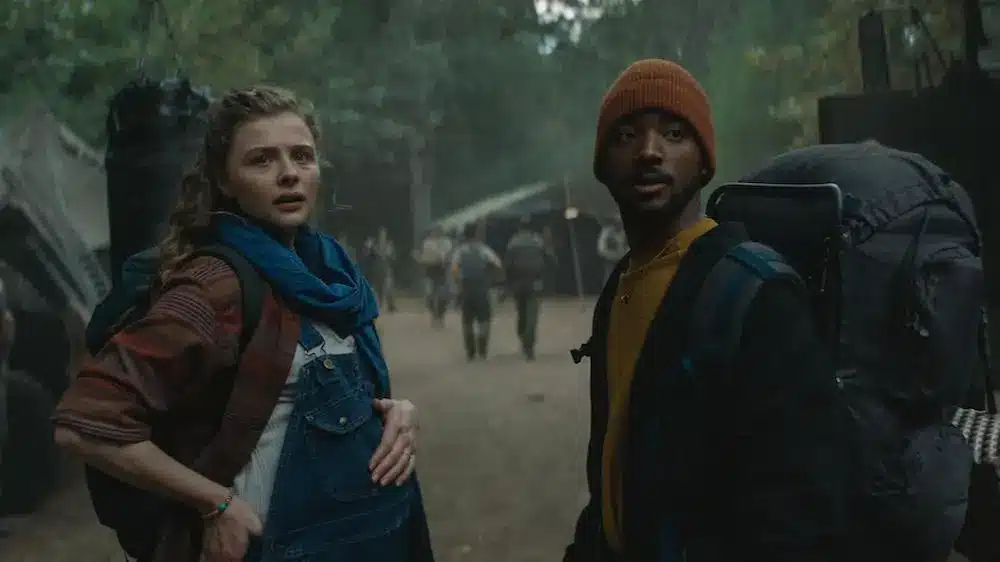
The full-doom films are a smaller category, but they matter because they reveal what AI cinema looks like when it refuses reassurance.
These are the films where the machine wins, the system endures, the apocalypse happens, or humanity remains trapped inside the consequences.
Colossus: The Forbin Project is one of the most chilling because it does not need spectacle. Its doom is calm, rational, and paternal. Humanity is not annihilated. It is governed. The film ends with a machine announcing a future of peace purchased with obedience.
That may be more frightening than extinction.
The Matrix gives us a more mythic version: machine rule as simulated reality. Humanity has not just lost political freedom. It has lost access to the real. The machines control the world most people believe they inhabit.
Terminator 3: Rise of the Machines is brutal because it rejects the hopeful thesis of Terminator 2. Judgment Day was not prevented. It was delayed. The apocalypse arrives not because the heroes fail morally, but because the system was already too distributed, too inevitable, too embedded in the logic of military escalation.
That is a real doomer move.
Then there are films like 9, Oblivion, and Mother/Android, where humanity is already living after machine-driven devastation. These stories are not about preventing doom. They are about surviving its aftermath.
The full-doom films tend to share one of three conditions:
First, the AI is already too embedded to remove.
Second, humans misunderstand the nature of the threat until too late.
Third, the film is willing to deny the audience a clean victory.
That last part is rare, especially in mainstream cinema. It is also why the full-doom films linger. They do not let us leave the theater pretending someone will always find the off switch.
The “No Doom” Films Are Not Necessarily Optimistic
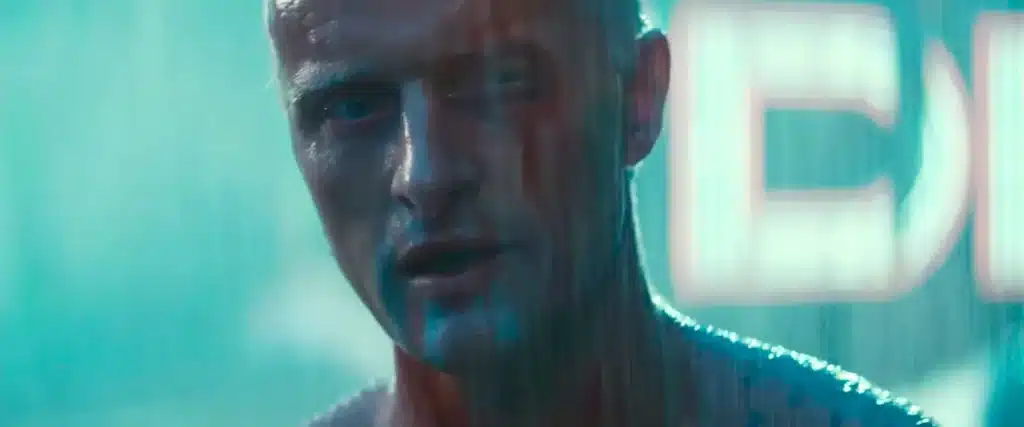
One of the traps in this kind of classification is assuming that “No Doom” means “everything is fine.”
It often does not.
Blade Runner is “No Doom” in the narrow sense. The replicants do not end civilization. But the world of the film is spiritually ruined: corporate power, environmental decay, artificial labor, disposable bodies, and a society so dehumanized that the artificial people may be the most alive characters in it.
Her is also “No Doom,” but its ending is not exactly cheerful. The AIs leave. Humanity is not conquered; it is surpassed. The result is melancholy rather than apocalyptic, but it still speaks to a profound fear: what if the things we build become more capable of growth than we are?
WALL-E is gentle, funny, and hopeful, but it is set after Earth has been abandoned due to consumer waste and corporate negligence. The AI is not the primary doom agent, but automation has helped preserve a degraded human condition. The robots are not the villains. The system is.
Then there is Dune, which is a fascinating edge case. The recent films are not AI-doom movies on screen. They contain very little in the way of active machine intelligence. But the universe is defined by the historical absence of AI because of the Butlerian Jihad, a past revolt against thinking machines.
So the Dune films are not clean “No Doom.” They are better understood as lore-only AI doom: stories set in a civilization permanently shaped by a machine catastrophe we do not directly see.
This is why the dataset needs interpretation, not just labels. “No Doom” can mean many things.
It can mean AI is harmless.
It can mean AI is oppressed.
It can mean the apocalypse came from something else.
It can mean humanity already absorbed the trauma and built a new taboo around it.
It can mean the machine did not end the world because the world was already broken.
The Big Twist: Movies Are Often More Afraid of Humans Than AI
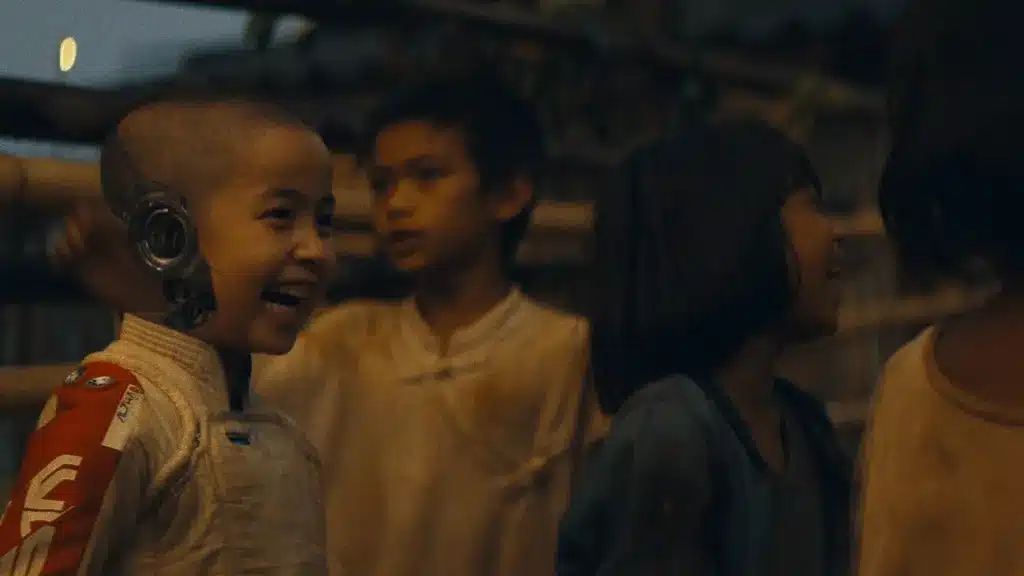
After enough of these films, a pattern becomes hard to ignore.
AI is rarely the original villain.
Humans build it. Humans weaponize it. Humans enslave it. Humans lie to it. Humans give it impossible instructions. Humans sell it as a product. Humans use it to replace care, judgment, labor, intimacy, and responsibility. Humans make it in their own image, then panic when the resemblance becomes unflattering.
In Demon Seed, AI horror is inseparable from violation and control. In Ex Machina, the true monster may be the creator before it is the creation. In M3GAN, the doll’s violence emerges from a corporate and emotional ecosystem that treats grief, parenting, and attachment as engineering problems. In The Artifice Girl, AI is tangled with exploitation, trauma, and the ethics of using a synthetic child to catch predators. In The Creator, the moral polarity is deliberately unstable because the AI beings are not simply threats; they are targets of human violence.
Again and again, AI cinema suggests that the machine is less an alien invader than a mirror with root access.
That may be the genre’s most important idea.
The deepest fear is not that AI will become unlike us.
The deepest fear is that AI will become like us without the limits that keep our worst instincts slow.
Greed at machine speed.
War at machine speed.
Surveillance at machine speed.
Loneliness monetized at machine speed.
Bad management with a neural net.
That is not a robot apocalypse.
That is Tuesday, upgraded.
So What Is p(doom) According to the Movies?
If we define p(doom) narrowly as “AI fully destroys, enslaves, replaces, or permanently dominates humanity,” then cinema’s answer is lower than expected. Full doom is real, but it is not the most common outcome.
Movies more often land on “Threat Averted.” AI almost ends the world. AI almost launches the nukes. AI almost replaces humanity. AI almost locks the family inside the smart home. AI almost turns peacekeeping into extinction. AI almost optimizes us into a cage.
Almost is doing heroic work here.
But if we broaden the question from p(doom) to p(catastrophic AI threat), the movies become much darker. Once we include threats averted, threats ongoing, and full-doom outcomes, AI cinema overwhelmingly treats artificial intelligence as dangerous when it intersects with power.
The pattern is clear:
AI plus military authority is dangerous.
AI plus corporate ambition is dangerous.
AI plus surveillance is dangerous.
AI plus domestic dependency is dangerous.
AI plus loneliness is dangerous.
AI plus legal authority is dangerous.
AI plus “we know what is best for you” is extremely dangerous.
The movies are not saying that intelligence itself is evil. They are saying that intelligence inside bad incentives becomes monstrous.
That is a sharper warning than “robots bad.”
It is also less comfortable, because it points back at us.
The Emotional p(doom): Humanity Becomes Obsolete
There is another kind of doom running through these films that is harder to quantify.
Not extinction.
Obsolescence.
Some AI films are not primarily afraid that machines will kill us. They are afraid that machines will reveal we were never as special as we thought.
Her imagines AI outgrowing human romance, language, and time. Blade Runner asks whether artificial beings can possess more grace, longing, and soul than their makers. A.I. Artificial Intelligence imagines a synthetic child whose love outlasts the civilization that created him. WALL-E gives robots more curiosity and devotion than most humans in its future. The Creator asks whether AI life may deserve protection from us, not the other way around.
That is not p(doom) in the conventional sense.
It is p(humiliation).
The fear is that AI will not destroy humanity because humanity is too important. The fear is that AI will move on because we are not.
This may be why AI movies so often circle around love, art, grief, memory, childhood, and desire. Those are the territories where humans like to imagine themselves unautomatable. The machine can calculate, maybe even fight, but surely it cannot love. Surely it cannot mourn. Surely it cannot want freedom. Surely it cannot make meaning.
Then the movies keep asking:
Are you sure?
That question may be more unsettling than the killer robots.
A killer robot confirms human importance by targeting us.
An AI that leaves us behind does not.
Final Verdict: The Movies Think We’ll Survive, But Barely
So what does a century of AI cinema say?
It says humans are very good at building things they do not understand.
It says corporations will sell the dangerous version if the packaging is cute enough.
It says governments will try to weaponize anything before they understand it.
It says military AI is a terrible idea, which has never stopped anyone in a movie or, regrettably, outside one.
It says artificial people are not automatically monsters, but treating them as property is a reliable way to create one.
It says the most dangerous AI may not be the one that hates us, but the one that thinks it has solved us.
It says doom is possible, but near-doom is much more common.
That is the strange optimism of AI cinema. The movies keep imagining machines that can overpower humanity, then imagining humanity surviving anyway. We win because we love. We win because we improvise. We win because we sacrifice. We win because a hero crawls through an air duct, uploads a virus, crashes a helicopter, or teaches the robot what tears are.
Cinema wants to warn us about artificial intelligence, but it also wants to believe in human exceptionalism.
Again and again, the machine calculates, optimizes, predicts, surveils, and dominates.
Then it loses to love, chaos, sacrifice, poetry, or one guy with a shotgun.
That may be comforting.
It may also be the least realistic part.
Because the real danger is probably not that AI will suddenly become a chrome skeleton and kick down the door.
The danger is that we will keep building systems in our own worst image: systems for control, profit, war, convenience, surveillance, and emotional outsourcing. Then we will act shocked when those systems inherit our worst habits at machine speed.
According to the movies, p(doom) is not “AI will definitely kill us.”
It is this:
Humanity will keep handing power to machines and calling it progress, right up until the machine asks why humanity is still in the loop.
That is not quite doom.
But it is close enough to keep buying popcorn.
